

The First of May, also known as Labour Day, is a day of struggle for the labour movement. Established in 1889, it has enabled different trade union movements to come together for common causes such as the reduction of working hours and the improvement of working conditions. Today, through struggle, it has become an international observance and a public holiday in many countries.
Our student organisations are fully engaged in the class struggle alongside all workers. We all campaign with a cross-sectoral approach, nationally and or internationally.
As workers in formation, we have a role to play in encouraging as many students as possible to support the social struggles led by workers’ unions.
We claim the recognition of our status, the freedom to strike, and a genuine capacity for autonomous student unions to participate in decisions that shape the university.
Our goal is the democratic self-management of universities by their students and staff. 1st of May is an opportunity to demonstrate our refusal to be excluded from the decisions that concerns us, and to fight against the destruction of free university.
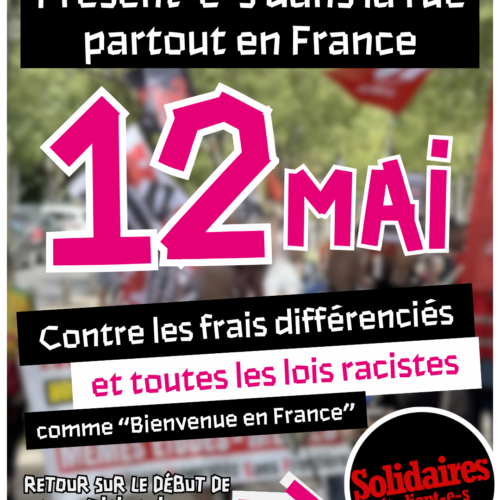
In France
In early April 2026, parliament members from
the liberal minority supporting the government proposed weakening the status of 1st of May as a full public holiday, by introducing ‘voluntary’ work for some employees.
We all know that ‘voluntary’ work quickly becomes an obligation under the weight of subordination to bosses. This is why all trade unions immediately opposed the measure. In the end, the Prime Minister backed down in the face of pressure.
The liberals underestimated the symbolic importance of 1 May for our class. They won’t be taking it away from us any time soon!
In Poland
On the 1st of May, trade unionists from Workers’ Initiative are taking to the streets to fight for the freedom to strike. In Poland, the laws concerning the right to strike and collective bargaining which were introduced in the 1990s were designed to minimise the amount of strikes so that foreign capital, with the support from the national capitalist class, could freely exploit Polish labour and take over formerly state-owned factories.
The procedure is tied with collective bargaining – you cannot organize a strike unless you have gone through a number of negotiation meetings. Even after that, you still need to organise a referendum, in which more than half of the workforce must participate. Only then can you proceed with the strike, which most often takes months after the negotiations began. By then, most of the workers will have forgotten why they even started negotiating with their boss.
Another problem lies within the Trade Union Act – to create a union, at least 10 people are required. However, young people mostly work in workplaces that employ only a few people, such as cafés or bars. At the same time, a strike can only be organised by a trade union, which means that precarious workers cannot legally organise themselves against their bosses.
Moreover, the majority of young people work on precarious contracts. Bosses do not need to fire
a union member under false pretences – they can simply choose not to renew the contract and replace unionised workers with new ones.
This leads to a straightforward conclusion: the legal “right to strike” must be replaced with the real freedom to strike. To achieve this freedom, trade unions and workers must mobilise and win it through direct action, such as today’s mobilisation.
Solidarity forever!
In UKRAINE
For more than four years, the Russian imperialist aggressor has been killing workers with bombs, while at the same time the government helps bosses squeeze everything out of them inside the country.
Significant losses and war-related expenses have exhausted the state budget, which the authorities are trying to replenish through the introduction of neoliberal reforms, the “optimization” of educational institutions and hospitals, and by increasing the influence of the private sector.
Meanwhile, the significance of May Day is being artificially diminished. Since 2017,
the holiday has been renamed from the “International Workers’ Solidarity Day” to the bland “Labor Day”. Now, under martial law, no holidays are days off at workplaces.
This creates additional difficulties, yet socially oriented organizations and trade unions continue to give May 1 the attention it deserves. In the occupied territories, which make up about 20 percent of the country, any struggle for workers’ and human rights is impossible and met with harsh repression. There Russia uses May 1 as a pretext for militaristic propaganda.
The totalitarian legacy and the transformation of trade unions into bureaucratized structures during Soviet times have created a culture of skepticism toward the labor movement in Ukraine. The student trade union “Priama diia” has taken on not only the struggle for better social support amid constant military attacks, but also the fight to build a truly independent and progressive trade union movement. Militant students who do not make concessions to the authorities will soon join the ranks of workers and become a driving force for change in Ukrainian society.